
Guangzhou A.C.T Products Co.,Ltd To Make The Global Delivery More Efficient
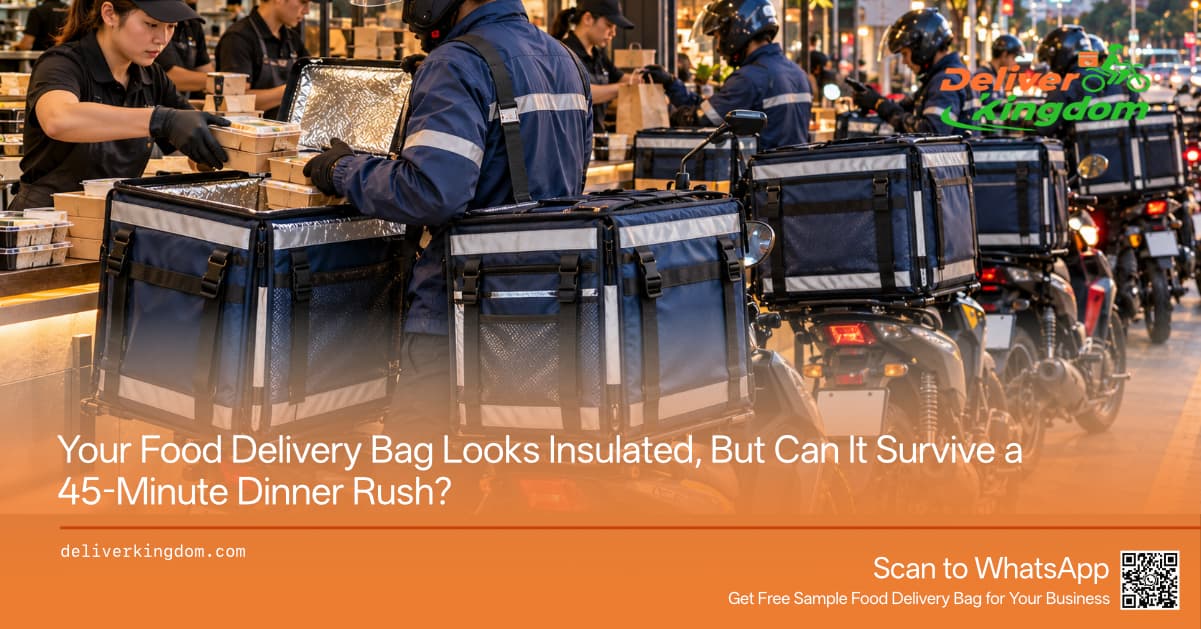
The Hidden Thermal Problems Behind Ordinary Food Delivery Bags
A restaurant orders 1,000 insulated food delivery bags. The supplier sends attractive product photos showing thick walls, reflective silver lining, waterproof fabric, and reinforced handles. The sample looks convincing, and the price fits the purchasing budget. Everything seems ready for production. But after the bags enter daily service, restaurant managers begin receiving complaints about meals arriving colder than expected. The problem is not necessarily that the insulation material is defective. Sometimes the bag loses too much heat through poorly fitted openings, compressed insulation, damaged corners, or repeated exposure to outside air. These weaknesses are difficult to identify from a product photograph. For restaurant chains, delivery platforms, catering businesses, and food logistics operators, choosing a temperature-tested food delivery bag for restaurant fleets means evaluating actual performance under realistic conditions rather than relying entirely on material descriptions. DeliverKingdom has specialized in food delivery bag manufacturing since 2013, supporting commercial buyers that require custom insulation, reliable construction, and repeatable production. Its manufacturing facility in Yangchun, Guangdong covers more than 12,000 square meters and employs over 400 workers, providing the foundation for customized product development and large commercial orders.
Why Thick Insulation Does Not Always Mean Better Temperature Retention
When comparing food delivery bags, purchasing managers often focus on insulation thickness. A bag with 15 mm foam may appear more advanced than one with 10 mm foam, but thickness alone does not determine thermal performance. Different insulation materials have different properties, and their effectiveness also depends on density, compression, moisture exposure, construction, and the quality of the complete bag assembly. A thick insulation layer cannot compensate for a poorly sealed opening or large gaps between structural panels. This is why a custom insulated food delivery bag for hot meal transport should be developed as a complete thermal system instead of a collection of impressive material specifications. DeliverKingdom offers customizable insulation structures using materials such as EPE foam, reflective aluminum foil lining, PEVA lining, PVC-coated polyester, Oxford fabric, and other suitable textile components. The combination can be adjusted according to the customer's required capacity, delivery duration, climate, and product category. A restaurant carrying hot rice meals for short urban routes may need a different configuration from a catering company transporting large food containers across several distribution points. Selecting the right construction helps buyers balance insulation, weight, flexibility, and manufacturing cost without adding unnecessary material that provides little practical improvement.
The Real Impact of Zippers, Seams, and Openings on Food Temperature
Insulation foam receives most of the attention in product marketing, but the opening system can have a major influence on thermal performance. Consider a delivery bag with thick insulated walls and a wide zipper opening that leaves gaps near the corners. Warm air can escape through these areas even when the main compartment is technically closed. Repeated pulling may also deform poorly supported openings over time, reducing how consistently the closure fits. A temperature-tested food delivery bag for restaurant fleets should therefore be evaluated as a complete product, including its lid, zipper, seams, corners, and supporting structure. DeliverKingdom supports different closure designs, including zipper systems, overlapping insulated flaps, Velcro connections, and reinforced openings. Buyers can customize the opening direction according to whether meals are loaded from the top or the front. For motorcycle delivery, a closure that remains easy to operate while the bag is mounted can reduce unnecessary handling. For catering applications, wider openings may improve loading convenience, although the thermal design must account for the additional exposed area. A better closure system does not simply make the bag look more professional. It helps maintain the intended internal environment while allowing restaurant staff and riders to work without struggling with the equipment during every order.
What Happens When Riders Open the Same Delivery Bag Repeatedly
A food delivery bag may perform well when it remains closed for thirty minutes, but actual restaurant delivery rarely works that way. A rider carrying several orders may open the compartment at the restaurant, close it, reopen it to add a missing drink, and then open it again at each customer destination. Every opening allows air exchange between the insulated compartment and the surrounding environment. During multi-stop delivery, the effect can accumulate, especially when the rider must search through several packages to locate the correct order. This is where internal organization becomes part of thermal protection. DeliverKingdom can develop a custom insulated food delivery bag for hot meal transport with removable dividers, separate access sections, horizontal shelves, order identification pockets, and different opening configurations. For restaurant chains, these features can reduce the amount of time the bag remains open during loading and handover. A delivery operator serving office buildings may prefer individual compartments for different orders, while a restaurant carrying larger family meals may benefit from one wide insulated chamber. There is no universal arrangement that works equally well for every menu. By matching the interior structure to the delivery process, buyers can reduce unnecessary air exchange while improving order organization and rider efficiency.
Testing Food Delivery Bags Under Real Restaurant Delivery Conditions
A meaningful thermal performance test should resemble the conditions in which the bag will actually be used. Simply placing a hot object inside the bag and checking the temperature after an unspecified period provides limited information. A more useful evaluation records the initial food or test-load temperature, ambient temperature, load quantity, bag configuration, number of openings, and measurement intervals. For example, a restaurant chain could compare two sample bags using identical meal containers, equal starting temperatures, and the same 45-minute delivery simulation. One test could keep the bags closed, while another could include several scheduled openings to represent multi-stop delivery. The resulting temperature measurements would provide more meaningful evidence than a general claim of long-lasting insulation. A temperature-tested food delivery bag for restaurant fleets should be assessed using a method that reflects the buyer's particular application. DeliverKingdom supports OEM and ODM sample development, allowing businesses to evaluate materials, dimensions, internal structures, closures, and insulation configurations before approving larger orders. The company can work with buyer-defined testing requirements and revise the product specification according to the findings. Actual temperature retention varies with the contents and test conditions, so performance targets should be confirmed through testing rather than assumed from foam thickness alone.
Custom Insulation Materials for Different Food Delivery Applications
Not every food delivery operation requires the same insulation structure. Pizza delivery, fried chicken transport, meal preparation services, beverage delivery, catering, and chilled grocery distribution create different thermal and physical demands. A pizza bag may need a wide horizontal compartment that protects flat boxes while retaining warmth. A fried chicken delivery bag may require attention to moisture management because excessive trapped condensation can affect food texture. Chilled products may require compatible cooling materials and a structure that limits heat entering from outside. DeliverKingdom develops food delivery bag solutions with customizable outer fabrics, insulation materials, inner linings, dimensions, and structural reinforcement. Available options can include waterproof Oxford fabric, PVC-coated polyester, TPU-coated fabric, EPE foam, aluminum foil lining, and PEVA inner surfaces. A custom insulated food delivery bag for hot meal transport can also include adjustable insulation thickness and different closure systems to match the required delivery time. For chilled and frozen distribution, buyers should specify the required temperature range and any cooling packs or temperature-control equipment used alongside the bag. Passive insulation alone cannot guarantee a particular food-safe temperature for every route. DeliverKingdom's customization capability allows restaurant groups, cold chain delivery companies, and food logistics operators to develop different product configurations instead of purchasing one standard model for every application.
Balancing Thermal Performance, Weight, and Rider Convenience
A delivery bag can have excellent insulation and still be a poor choice if it is too heavy, bulky, or difficult to use. Riders may carry the same equipment for several hours during busy shifts, repeatedly lifting it onto motorcycles, moving it through restaurant entrances, and carrying it across residential buildings. Adding thicker foam and rigid support panels without considering the overall weight can create discomfort and reduce usability. A custom insulated food delivery bag for hot meal transport should balance thermal performance with carrying comfort, structural stability, and practical access. DeliverKingdom supports lightweight construction options, adjustable shoulder straps, reinforced carrying handles, breathable back panels, foldable structures, and removable internal supports. Zipper or Velcro closure systems can be selected based on the required sealing performance and opening frequency. Restaurant chains using motorcycle couriers may prefer a structured rear-mounted model, while bicycle delivery teams may require a lighter backpack with comfortable shoulder support. Catering companies may prioritize reinforced side handles and stable bottom panels. These choices help buyers develop equipment that suits actual delivery operations rather than maximizing one specification at the expense of everything else. The most suitable bag is not necessarily the thickest or largest model. It is the one that maintains an appropriate balance between food protection, rider convenience, durability, and operating cost.
Why Restaurant Chains Need Consistent Insulation Across Bulk Orders
A restaurant chain may approve a carefully developed delivery bag sample only to discover that later shipments do not perform quite the same way. Even small changes in insulation material, foam thickness, lining construction, closure placement, or finished dimensions can affect the final product. For a company purchasing thousands of bags across several regions, production consistency becomes a critical procurement requirement. A bulk food delivery bag manufacturer for delivery companies should be able to work from confirmed materials, technical specifications, approved samples, and inspection requirements. DeliverKingdom operates a manufacturing facility covering more than 12,000 square meters in Yangchun, Guangdong, with over 400 employees supporting commercial production. The company holds BSCI and ISO9001 certification, providing buyers with recognized references for responsible factory practices and quality-management systems. These certifications support supplier evaluation, although they should not be mistaken for product-specific thermal performance certification. Buyers can establish documented requirements for insulation materials, dimensions, stitching, closure construction, logo placement, and packaging before production begins. Where thermal performance is critical, agreed sample tests and appropriate production verification can also be incorporated into the approval process. This gives procurement teams a clearer basis for accepting future shipments and helps prevent the equipment standard from gradually changing as the business expands.
Why Choose DeliverKingdom for Custom Food Delivery Bag Manufacturing
Finding a supplier capable of sewing an insulated bag is relatively easy. Finding a manufacturing partner that can accommodate different operating conditions, custom specifications, branded equipment, and repeated commercial orders requires more careful evaluation. DeliverKingdom was established in 2013 and is headquartered in Guangzhou, China. Its production factory in Yangchun, Guangdong covers more than 12,000 square meters and employs over 400 workers. With BSCI and ISO9001 certification, DeliverKingdom provides international procurement teams with useful factory and quality-management references. The company specializes in food delivery bags, thermal backpacks, insulated tote bags, rider helmets, jackets, and protective equipment, making it suitable for businesses seeking coordinated delivery equipment. As a bulk food delivery bag manufacturer for delivery companies, DeliverKingdom supports OEM and ODM development, fabric selection, customized dimensions, insulation thickness adjustment, color matching, logo printing, internal compartment design, and large-order manufacturing. Branding options include silk screen printing, heat transfer printing, embroidery, woven labels, and reflective printing according to project requirements. More importantly, buyers can develop a bag around actual delivery routes, food packaging, vehicle types, and environmental conditions. This practical approach helps restaurant chains, food logistics providers, cold chain operators, and trading companies move beyond generic product selection and build equipment specifications that can support long-term operations.
Building a Better Food Delivery Bag Before Mass Production Begins
The most expensive time to discover a design problem is after thousands of food delivery bags have already been manufactured. Before approving a commercial order, procurement teams should confirm the actual internal dimensions, target food packaging, expected carrying weight, preferred materials, insulation structure, opening method, cleaning requirements, and delivery conditions. A sample should be loaded with the intended containers and tested under representative operating conditions. For a temperature-tested food delivery bag for restaurant fleets, buyers can establish measurable thermal performance targets and compare the results of different insulation configurations. For a custom insulated food delivery bag for hot meal transport, they may also evaluate whether dividers, insulated flaps, or different closure systems improve the practical loading and delivery process. DeliverKingdom supports custom fabric, size, color, insulation, logo printing, and structural development through OEM and ODM manufacturing. Its factory scale and commercial production capabilities support buyers that require both initial orders and future replenishment. Restaurant chains, delivery platforms, catering companies, food logistics businesses, and trading companies can submit their food container dimensions, average delivery time, expected order quantity, preferred materials, and logo artwork to discuss a suitable design and sample plan. The objective is straightforward: confirm the product's suitability before the large order begins, rather than discovering during the dinner rush that a visually impressive thermal bag was never properly matched to the job.
Q: Does thicker insulation always make a food delivery bag better?
A: No. Thermal performance depends on insulation material, thickness, construction, closure design, ambient temperature, food temperature, and how frequently the bag is opened. DeliverKingdom can customize insulation configurations according to the intended delivery application.
Q: Can DeliverKingdom develop a food delivery bag for a specific delivery time?
A: Yes. Buyers can provide their target delivery duration, food type, operating temperature, and required performance conditions. DeliverKingdom can develop suitable material and structural options for sample evaluation. Actual temperature retention should be verified through testing under representative conditions.
Q: Can the insulation thickness, fabric, and closure design be customized?
A: Yes. DeliverKingdom supports customized foam insulation, outer fabrics, inner linings, zipper systems, Velcro closures, insulated flaps, dimensions, colors, internal compartments, and logo printing through OEM and ODM development.
Q: Why choose DeliverKingdom for bulk food delivery bag manufacturing?
A: DeliverKingdom has specialized in delivery equipment manufacturing since 2013 and operates a factory covering more than 12,000 square meters with over 400 workers. The company supports OEM and ODM customization, sample development, material selection, large commercial orders, and repeat production. DeliverKingdom also holds BSCI and ISO9001 certification.
Q: What information should buyers provide before requesting a quotation?
A: Buyers should provide the required dimensions, expected order quantity, food container measurements, average delivery duration, target temperature requirements, operating climate, preferred fabrics, insulation specifications, logo artwork, and any special features such as internal dividers, waterproof lining, reinforced handles, or foldable construction.

 احصل على عرض أسعار عبر الإنترنت